
Menu
Menu
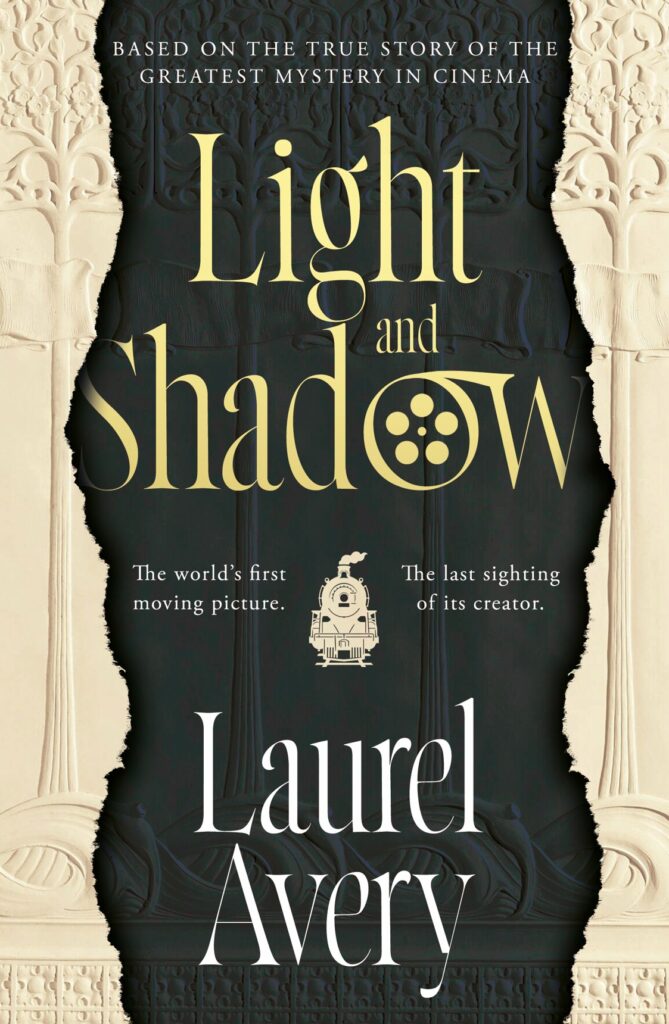
We think that Lincrusta Art Nouveau pattern looks fabulous on the cover of Light & Shadow, Laurel Avery’s gripping historical mystery about ambition, secrets and the forgotten father of cinema.
It was not however picked purely for its aesthetic or light reflecting qualities. It turns out that the book’s protagonist Augustin Le Prince is linked with the introduction of Lincrusta into the US.
So, who was Augustin Le Prince?
Before cinema had Thomas Edison or the Lumière brothers, an artist, scientist and inventor with a remarkable connection to Lincrusta was experimenting with a new way of capturing the world.
Louis Aimé Le Prince known as Louis Le Prince and to his family as Augustin, is today recognised as one of the great pioneers of early cinematography. His journey to the moving image crossed art, chemistry, photography, decorative design and industrial innovation, including a period working with Lincrusta-Walton. [1][2]
From France to Leeds
Le Prince was born in Metz, France, on 28 August 1841. His father was an army officer and a friend of Louis Daguerre, one of the pioneers of photography. As a young man, Le Prince is believed to have spent time in Daguerre’s studio, gaining an early exposure to photography and photographic chemistry. He later studied art alongside science and chemistry, a combination that would influence much of his working life. [1][3] [museumsand…eds.gov.uk], [victorian-cinema.net]
In 1866, Le Prince moved to Leeds through his friendship with John Robinson Whitley, joining the Whitley family’s engineering business, Whitley Partners, brass founders based in Hunslet. Leeds was a rapidly developing centre of industry and invention, and it would become central to both his personal life and his later experiments. [1][4] [museumsand…eds.gov.uk], [oldsite.th…sby.org.uk]
Three years later, in 1869, he married John Robinson Whitley’s sister, Elizabeth ”Lizzie” Whitley, herself an accomplished artist. Combining Elizabeth’s artistic skills with Louis’s interests in art, science and technology, the couple established a school of applied art at 33 Park Square, Leeds. Leeds Museums and Galleries records the school opening in 1874, offering practical training in art and decorative techniques. [1][4] [museumsand…eds.gov.uk], [oldsite.th…sby.org.uk]
Their work went beyond conventional painting. Together, they experimented with ceramics and enamelling and developed techniques for fixing photographic images onto materials such as metal and pottery. Their work attracted considerable recognition, including commissions connected with portraits of Queen Victoria and William Gladstone. [1][3] [museumsand…eds.gov.uk], [victorian-cinema.net]
It was an unusual combination of art, material, chemistry and manufacture, and one that would prove particularly relevant to the next chapter of Le Prince’s life.
The Lincrusta Link
In 1881, Le Prince travelled with his family to the United States in connection with Lincrusta-Walton.
Through his development of this decorative material and his previous invention Le Prince, with his background in applied art, decorative surfaces and industrial processes, Lincrusta represented a natural meeting point between art and manufacture.
The former National Museum of Photography, Film and Television’s account of Le Prince‘s life records that he moved to New York with his family “to work on the development of the Lincrusta wallpaper process”, in which his brother-in-law John Robinson Whitley had an interest. Other biographical histories describe Le Prince as travelling to America as an agent for Lincrusta-Walton. [2][5] [nmpft.org.uk]
It places Lincrusta at a fascinating point in Le Prince’s story: between the applied arts of his Leeds years and the photographic experiments that would eventually secure his place in the history of film.
From Decorative Art to Moving Pictures
While in America, Le Prince’s attention increasingly turned towards an ambitious technical challenge: capturing movement through photography.
Importantly, this fascination appears to have pre-dated his American years. His wife Elizabeth later recalled that his ideas about “moving photographs” and his earliest experiments in finding suitable materials for film went back to their time at Park Square in Leeds, before the journey to New York. [2] [nmpft.org.uk]
America nevertheless became an important setting for developing those ideas. Le Prince had access to workshop facilities at the New York Institute for the Deaf, where Elizabeth taught art. During this period he developed a camera employing sixteen lenses and, in 1886, applied for an American patent for his moving-picture technology. [2][3] [nmpft.org.uk], [victorian-cinema.net]
The sixteen-lens design was ingenious but complex. The decisive development would come after his return to Leeds.
The World’s First Films
Le Prince returned to Leeds in May 1887 and established a workshop at 160 Woodhouse Lane. Here, he developed a far more practical single-lens camera, designed to capture a sequence of images from the same viewpoint. [2][3] [nmpft.org.uk], [victorian-cinema.net]
In October 1888, he took his camera to the Whitley family home at Roundhay and filmed a group of family members walking in the garden.
https://publicdomainreview.org/collection/roundhay-garden-scene-1888
The surviving frames became known as Roundhay Garden Scene. Lasting only a few seconds, it is nevertheless regarded as one of the earliest surviving motion-picture film sequences made using a single-lens camera. Le Prince also filmed traffic and pedestrians crossing Leeds Bridge, preserving an extraordinary glimpse of everyday Victorian life in motion. [1][5] [museumsand…eds.gov.uk]
These experiments preceded the celebrated cinematographic achievements of Thomas Edison and the Lumière brothers by several years. Yet Le Prince would never have the opportunity to develop his invention commercially or demonstrate it to a mass audience.
In September 1890, while travelling in France and preparing to return to America, he disappeared. Neither Le Prince nor his luggage was conclusively found, and the circumstances surrounding his disappearance remain unresolved. [5]
The Novel Synopsis
On the eve of presenting the first motion picture camera to the world, five years before the Lumière brothers, its inventor, Augustin Le Prince, stepped onto a train from Dijon to Paris and vanished without a trace.
Concerned that Edison’s spies were monitoring his experiments, Le Prince left his family in New York to work in relative privacy in England. In 1888, he filmed the world’s first moving picture in a garden in Leeds.
Two years later, after his experiments had strained both his finances and his marriage, Le Prince was finally ready to present his invention to some of Gilded Age New York’s most illustrious patrons, securing his place in film history. First, however, he had to persuade his brother to settle their late mother’s estate and relieve him of the crushing debts he had not dared reveal to his family. But just before sailing to New York, Le Prince boarded a train in Dijon and was never seen again.
His family and friends made concerted efforts to find him, but their searches yielded nothing. Had Le Prince chosen to disappear in order to conceal secrets he was hiding, or was something more sinister at work? [7]
Laurel Avery, author of Light and Shadow, is a dress historian, owner of Edwardian Recreations, and former museum educator. A native New Yorker with a love for historical detail, she has lived in Europe for over two decades and travelled extensively in France, the UK, and US in the course of researching the book.
The book is available to buy HERE.
References
[1] Leeds Museums and Galleries – The Life, Mystery and Legacy of Louis Le Prince
A useful account of Le Prince’s early life, move to Leeds, marriage, School of Applied Arts and subsequent film experiments.
Read the article
[2] National Museum of Photography, Film and Television – Pioneers of Early Cinema: Louis Aimé Augustin Le Prince
Particularly valuable for the connection between Le Prince’s move to America and Lincrusta-Walton, as well as his wife’s account of his early interest in moving photography.
Read the archived publication
[3] Who’s Who of Victorian Cinema – Louis Aimé Augustin Le Prince, Stephen Herbert
Covers Le Prince’s artistic and scientific background, Leeds career and development of his moving-picture apparatus.
https://web.archive.org/web/20060721184745/http://www.victorian-cinema.net/leprince.htm [victorian-cinema.net]
[4] Thoresby Society – Louis Aimé Augustin Le Prince: They Lived in Leeds
Detailed account of the Whitley family connection, Le Prince’s arrival in Leeds, marriage to Elizabeth and their artistic work.
Read the article
[5] BBC – Louis Le Prince, who shot the world’s first film in Leeds
Background to Le Prince’s Leeds’ years, pioneering films and disappearance.
https://www.bbc.co.uk/news/entertainment-arts-33198686
[6] Wikipedia – Louis Le Prince
Useful secondary overview with an extensive bibliography and links to further historical material.
https://en.wikipedia.org/wiki/Louis_Le_Prince
[7] Book Guild https://bookguild.co.uk/bookshop/historical/light-and-shadow
Get Updates & Offers From Lincrusta
© Lincrusta Factory, Unit 11 Southgate, White Lund Industrial Estate, Morecambe, LA3 3PB

