
Menu
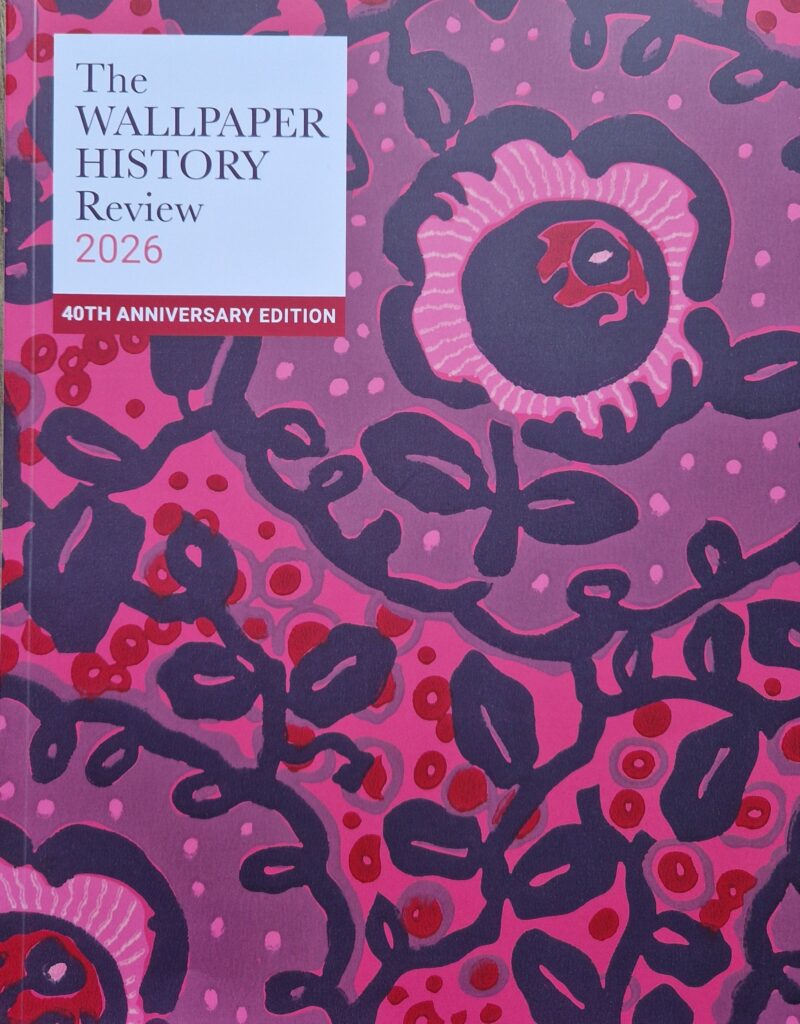
The 40th Anniversary Edition of the Wallpaper History Society Review, features an article on the fabulous renovation project of the Mayoral Parlour at Rochdale Town Hall.
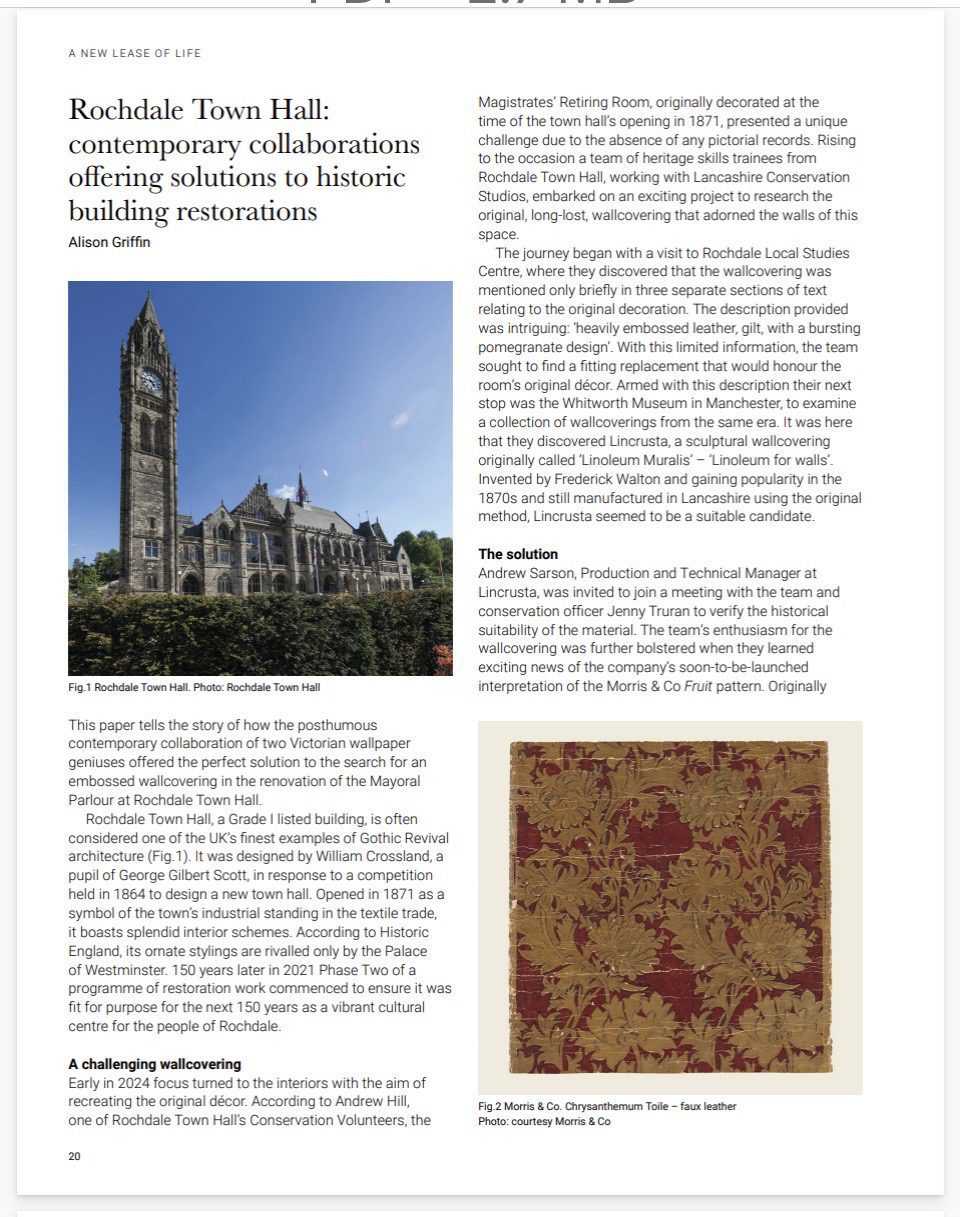
Rochdale Town Hall, a Grade I listed building, is often considered one of the UK’s finest examples of Gothic Revival architecture It was designed by William Crossland, a pupil of George Gilbert Scott, in response to a competition held in 1864 to design a new town hall. Opened in 1871 as a symbol of the town’s industrial standing in the textile trade, it boasts splendid interior schemes. According to Historic England, its ornate stylings are rivalled only by the Palace of Westminster. 150 years later in 2021 Phase Two of a programme of restoration work commenced to ensure it was fit for purpose for the next 150 years as a vibrant cultural centre for the people of Rochdale.
A challenging wallcovering
Early in 2024 focus turned to the interiors with the aim of recreating the original décor. According to Andrew Hill, one of Rochdale Town Hall’s Conservation Volunteers, the Magistrates’ Retiring Room, originally decorated at the time of the town hall’s opening in 1871, presented a unique challenge due to the absence of any pictorial records. Rising to the occasion a team of heritage skills trainees from Rochdale Town Hall, working with Lancashire Conservation Studios, embarked on an exciting project to research the original, long-lost, wallcovering that adorned the walls of this space.
The journey began with a visit to Rochdale Local Studies Centre, where they discovered that the wallcovering was mentioned only briefly in three separate sections of text relating to the original decoration. The description provided was intriguing: ’heavily embossed leather, gilt, with a bursting pomegranate design’. With this limited information, the team sought to find a fitting replacement that would honour the room’s original décor. Armed with this description their next stop was the Whitworth Museum in Manchester, to examine a collection of wallcoverings from the same era. It was here that they discovered Lincrusta, a sculptural wallcovering originally called ‘Linoleum Muralis’ – ‘Linoleum for walls’. Invented by Frederick Walton and gaining popularity in the 1870s and still manufactured in Lancashire using the original method, Lincrusta seemed to be a suitable candidate.
The solution
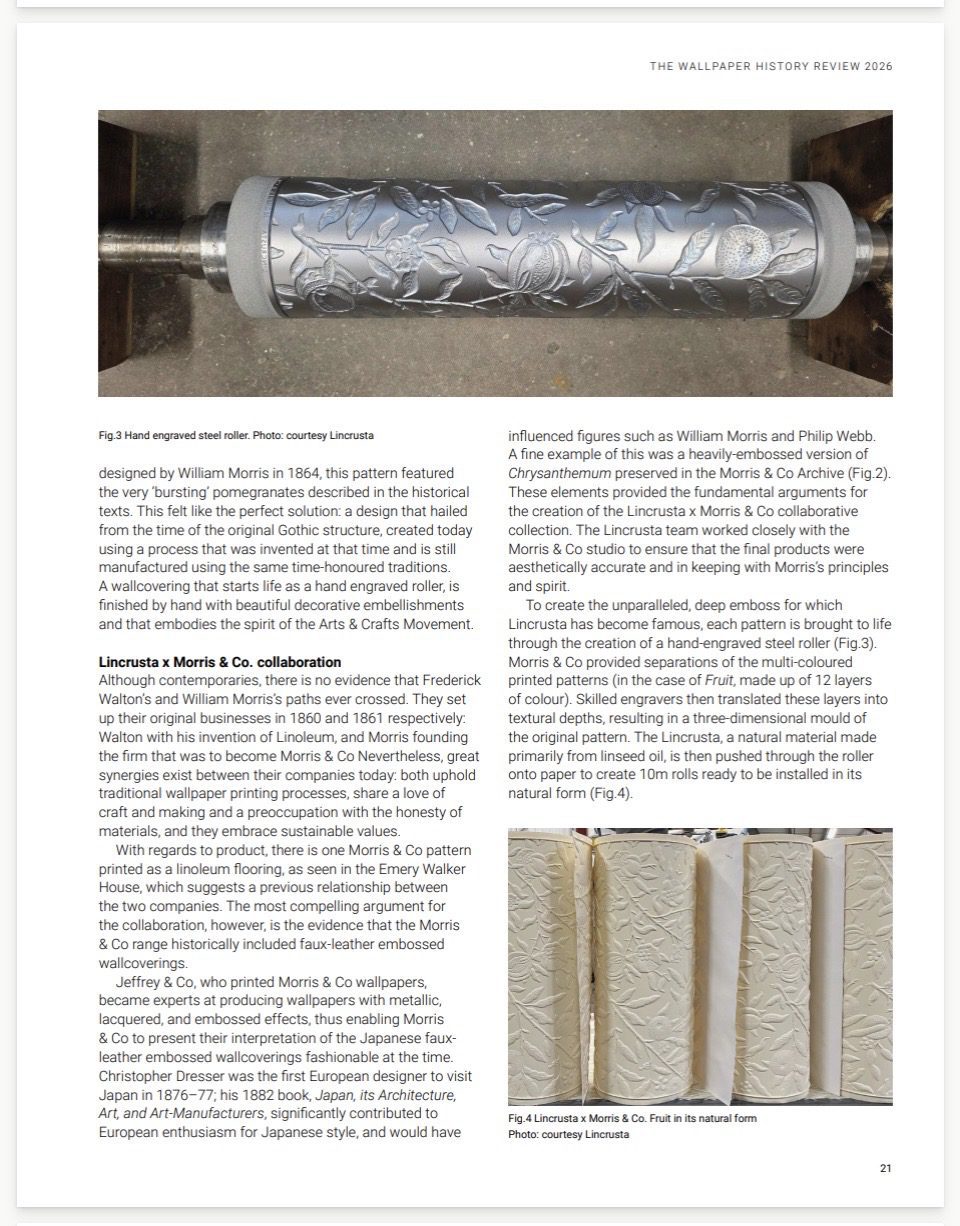
Andrew Sarson, Lincrusta Production and Technical Manager was invited to join a meeting with the team and conservation officer Jenny Truran to verify the historical suitability of the material. The team’s enthusiasm for the wallcovering was further bolstered when they learned exciting news of the company’s soon-to-be-launched interpretation of the Morris & Co. Fruit pattern. Originally designed by William Morris in 1864, this pattern featured the very ‘bursting’ pomegranates described in the historical texts. This felt like the perfect solution: a design that hailed from the time of the original Gothic structure, created today using a process that was invented at that time and is still manufactured using the same time-honoured traditions. A wallcovering that starts life as a hand engraved roller, is finished by hand with beautiful decorative embellishments and that embodies the spirit of the Arts & Crafts Movement.
The Execution
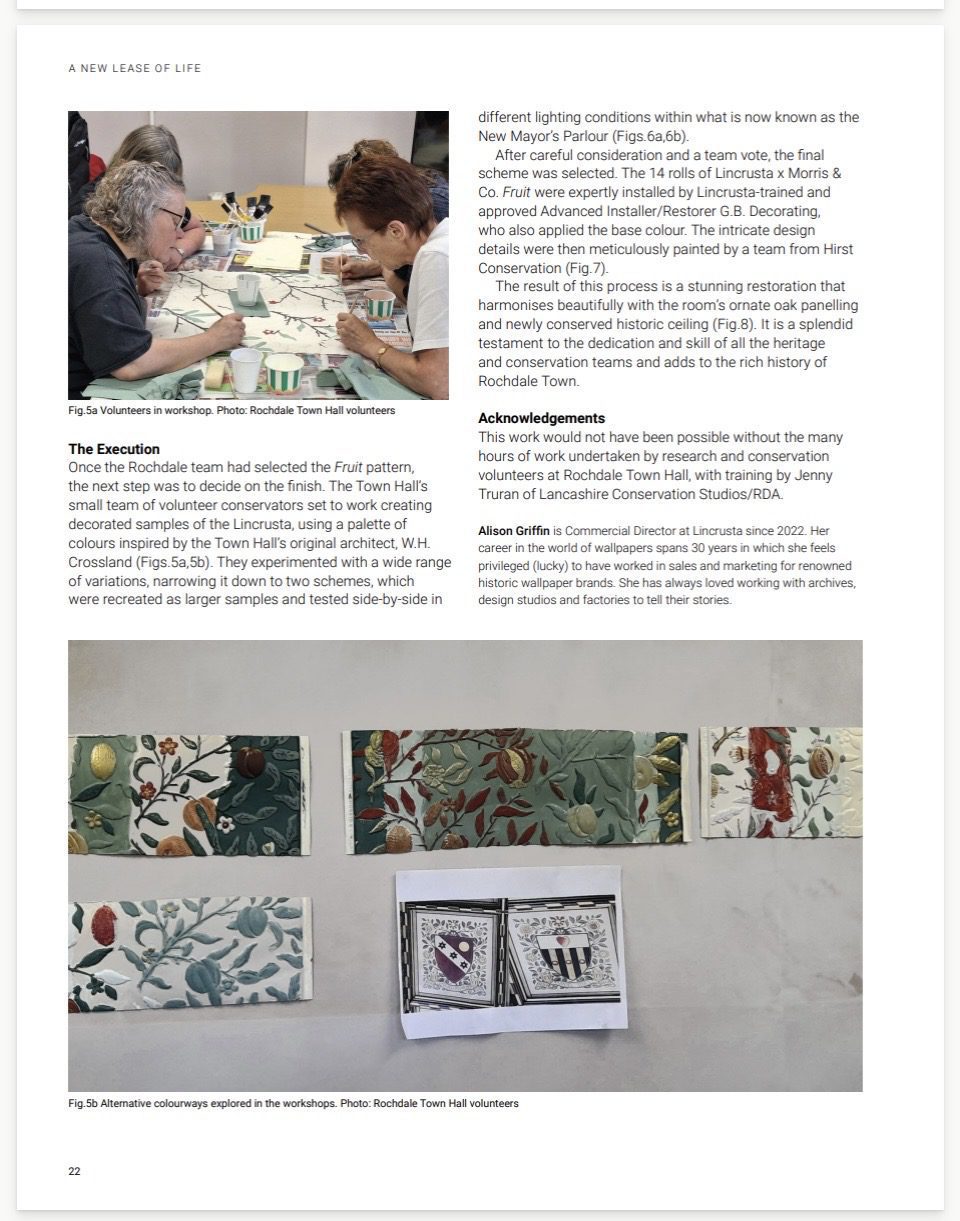
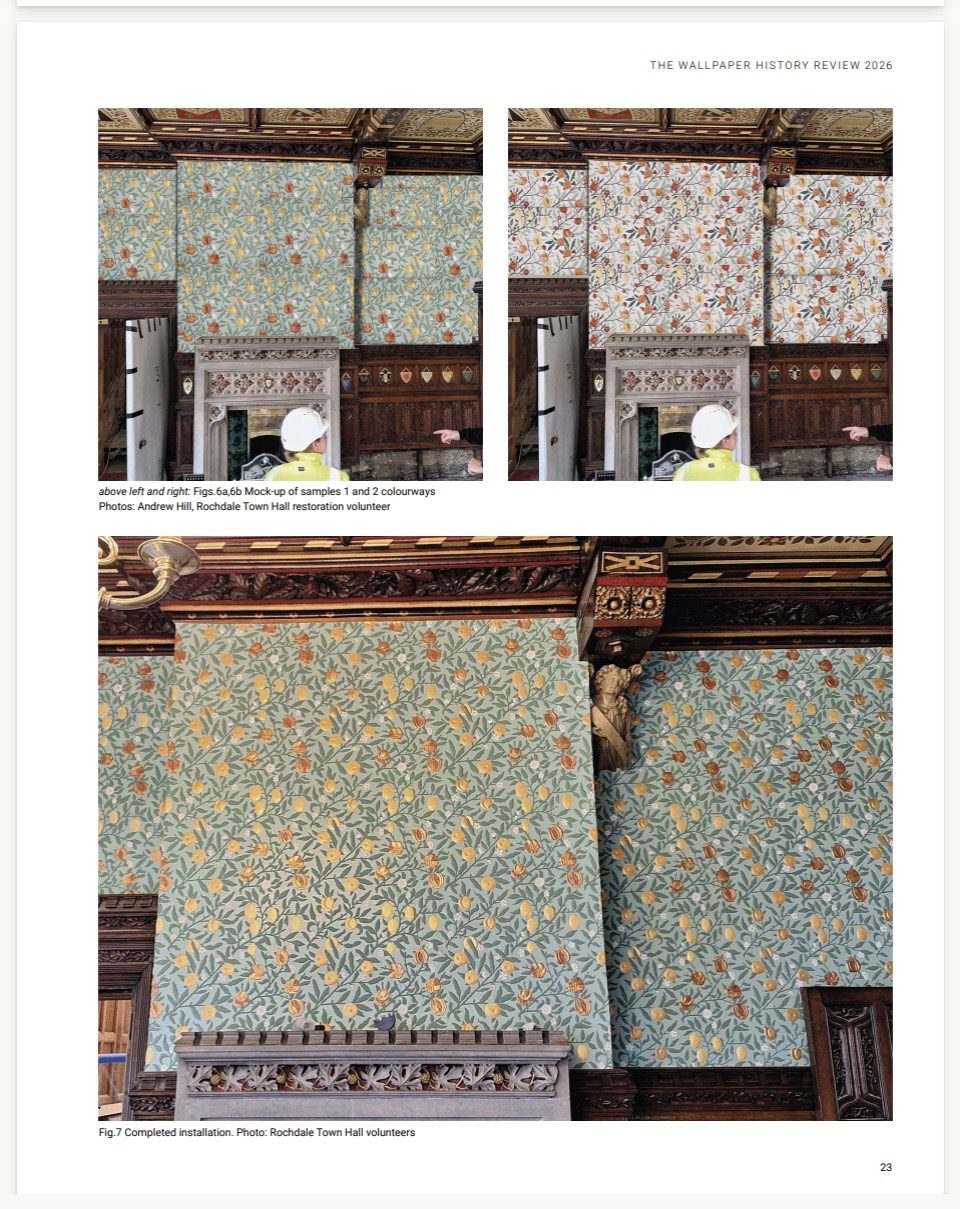
Once the Rochdale team had selected the Fruit pattern, the next step was to decide on the finish. The Town Hall’s small team of volunteer conservators set to work creating decorated samples of the Lincrusta, using a palette of colours inspired by the Town Hall’s original architect, W.H. Crossland. They experimented with a wide range of variations, narrowing it down to two schemes, which were recreated as larger samples and tested side-by-side in different lighting conditions within what is now known as the New Mayor’s Parlour.
After careful consideration and a team vote, the final scheme was selected. The 14 rolls of Lincrusta x Morris & Co. Fruit were expertly installed by Lincrusta-trained and approved Advanced Installer/Restorer G.B. Decorating, who also applied the base colour. The intricate design details were then meticulously painted by a team from Hirst Conservation.
The result of this process is a stunning restoration that harmonises beautifully with the room’s ornate oak panelling and newly conserved historic ceiling. It is a splendid testament to the dedication and skill of all the heritage and conservation teams and adds to the rich history of Rochdale Town.

